Home   |   About Me   |   Contents   |   Contact   |   Links   |   Acknowledgements   |   Subscribe

Showing posts with label Gilbert & Sullivan. Show all posts

15 May 2023

53. Lost (and found) in translation

As the academic term winds down, I find time to get to that stack of books unwrapped at Christmas.  In the preface of The Cambridge Encyclopedia of Historical Performance in Music (ed. Colin Lawson and Robin Stowell), I read these words:

The musical score itself is an imprecise mechanism, which by its very nature offers even the most dutiful performer a rich variety of possibilities.  There has always been much detail that a composer did not trouble to notate, knowing that certain conventions would be observed; some of these are no longer current or have undergone significant changes of meaning.  For example, musical notation can give little indication of tempo flexibility or the balance of instruments within an ensemble.  Those elements of style which a composer found it unnecessary to notate will always have the character of a foreign language, but one within which todays musicians can learn to converse freely.  Using the resources and techniques for which a particular repertory was intended may well make more sense of what the composer actually wrote, recreating something of its initial impact on the listener [p. xvi].

Indeed; and while I object to the notion of music as a universal language (on which see the late, great Linda Shaver-Gleason), the comparison here with a language in which one may gain fluency, with a fuller sense of idioms and subtexts, makes a lot of sense to me.  Such fluency will never be that of a native-speakerwe cannot be reborn in seventeenth century Europe (nor would I wish to be)but with eyes open and ears attuned, an immersion into as much of that musics culture that we can find may at least lead us in the right direction.  Whatever that is.

I remember years ago hearing a snide reference to a certain university music department as one in which music is seen and not heard.  I get it.  Musicologists can get wrapped up in the text and forget the experience.  I recognize in myself the tendency, when in museums, to look first to the commentary before I look at whatever is inside the framewanting to know what I'm looking at, maybe even what Im supposed to see.  I'm probably more comfortable in the scholarly conversation (discourse is the word that was hammered into me in graduate school) than in the aesthetic experience.  No real surprise there, as I have much more in common with the critics than the creators.  Part of what has made the historically-informed performance movement so vibrant, I think, is the interchange between musicologists and musicians:  each has much to learn from the other.  Instruments can teach us what the text is saying, just as much as the philologist can seek to elucidate a particular reading within the larger context of a textual tradition.

As any reader of the blog knows, my concern here is about the musical text, almost always the notated text.  The text is frozen and lifeless, rather like the specimen in the biology laboratory.  Music-as-written is not the live creature in its natural habitat; that would be the music-as-sounded.  The notated text is at best a translation (a transubstantiation, even?) of the musical experience into written form.  Its medium is changed, and whatever new potential this new state affords, this necessarily comes with many costs as well.  Something is always lost in translation.  Even more than this, the notated text cannot be regarded as an end in itself, seen and not heard; rather, it is a means to another end, and it must be reawakened in a new resurrection of the music in sound.  (I offer no apologies for the religious language in this paragraph; I think there are useful connections to be made, if youre interested you can read more in this prehistory of Settling Scores.)

And this text-as-lifeless-remnant is as true of recordings as of notated music.  A recording is music-as-sounded in only the most literal sense.  Otherwise, it is as frozen as the most prosaic printed page.  As Hua Hsu comments in a perceptive review of a lavish limited edition that presents (one is led to believe) an audio document of 1969 Woodstock festival from idealistic start to muddy end, Listening to thirty-eight CDs brings you no closer to experiencing such felicity and innocencethe possibility in the trippers brittle laugh.  Theres the past, and theres the story we tell about it [p. 73].  Memory is fickle, and whatever text survives is all we have, for better or worse.  But text is also fickle.  It is only what happens to have been preserved, a mixture of intention and carelessness.

The CD cover features a close up of Bob Dylan's face, circa 1960s, in sepia tones
SOURCE:  discogs.com
A few years ago, I heard a fascinating paper at the annual meeting of the Society for Textual Scholarship.  Alan Galey (who is in the Faculty of Information at the University of Toronto) was addressing what he called digital streaming lacunaehow audio streamed from platforms such as iMusic or Spotify may lack information that would be heard on the corresponding compact disc.  The example that has stuck with me was from the fourth volume of Columbia Records Bootleg Series of Bob Dylan recordings.  The cover says The Royal Albert Hall Concert, although the source recording is actually from the May 17, 1966 Manchester Free Trade Hall concertand the quotation marks around Royal Albert Hall acknowledge that there has been fan confusion about this recording for decades (noted, too, on the back cover).  In any case, this CD release preserves the famous heckling fan shouting Judas!  

SOURCE:  discogs.com

Galey noticed, however, that if one accesses this recording via any of the streaming services, this most-famous moment is missing.  Moreover, there is nothing to indicate that something is missing.  It may as well have been intentionally edited out.

What Galey discovered, however, was that omission was oversight, not intention.  On the Columbia CD, the Judas! exchange (as well as other things between the songs) were coded as pre-gap.  (Those of us old enough to remember compact discs can recall seeing the timer display sometimes indicate negative numbers right before a track started:  -00:03, -00:02, -00:01, 00:00 [start].  That is the pre-gap.)  Whoever was assigned to rip the CDs to provide the files to the streaming services neglected to check off Include pre-gap in the dialogue box, and so those sections simply disappeared, absent from the data.  Consequently the streamed version of this album is more than three minutes shorter than the CD release it purports to represent.  The non-musical moments of the album have been lost in the translation from one digital medium to another.  Even more alarming:  the digital text is not quite as fixed as we might have assumed.

As intriguing as that example is, I am much more interested in the disconnect between words and music--that is, where the words used to clarify the musical idea prove utterly insufficient, maybe because they are too slippery.  Felix Mendelssohn, in an oft-quoted letter of November 1842, rails about precisely this problem; I quote here the translation by John Michael Cooper (who also writes illuminatingly on the context and significance of this letter):

There is so much spoken about music, and yet so little is said. I believe that words are entirely insufficient for that, and if I should find that they were sufficient, then I would write no more music.  People usually complain that music is ambiguous; that what they should think of when they hear it is so unclear, whereas everyone understands words; but for me it is just the opposite, and not just with entire discourses, but also with individual words; these, too, seem to me so ambiguous, so unclear, so misleading in comparison to good music, which fills one’s soul with a thousand things better than words.—What the music I love expresses to me is thought not too unclear for words, but rather too clear.  I therefore find in all attempts to put these thoughts into words something correct, but also always something insufficient... [p. 159].  

Mendelssohn goes on to state that the music would arouse the same feeling in one person as in another.  Im not as sanguine about that, but I do agree with him that we are wrong to assume that our words are infallibly communicating what we intend.  

I ran across an example of this recently, working on a review of Breitkopf & Härtels impressive new edition of Mahler's third symphony.  Near the beginning of the second movement there is an interesting footnote in which Mahler endeavors to clarify his poco riten. instruction:
In the fourth measure of the excerpt the instruction "Poco ritenuto" has an additional instruction for the 2nd violins, cued by an asterisk to the footnote in German and English.
SOURCE:  cropped page scan (p. 114), showing bb. 29-35 of the second movement from Gustav Mahler, Symphonie nr. 3, ed. Christian Rudolf Riedel (Breitkopf & Härtel, 2021).

In case that print it is too small for you, it reads (in its English version):  The 16th-notes always in the same tempo; the rit. should be in the rests.  This is not a literal translation of the German:  immer gleich schnell [always as quickly] for the 16th-notes isnt quite the same tempo, but I think we understand what he means.  As the beat slows, the length of the 16th-notes does not get appreciably longer.  He explains that the slowing happens in the rests [in die Pausen].  But look at the second violin line in b. 32, where we find the asterisk indicating the foot note:  there are no rests.  

SOURCE:  enlarged detail of image of above

A previous editor, Erwin Ratz, tried to fix this in his 1974 edition.  He decided to replace Mahlers word Pausen [rests] with Punkte [dots (i.e., on the eighth notes)]:

First edition reads "das rit in die Pausen zu verlegen."  The 1974 edition reads "das rit in die Punkte zu verlegen."
SOURCE:  detail of p. 106 of a) first edition (Weinberger, 1898) available as IMSLP 109864; and b) revised edition ed. Erwin Ratz (Universal, 1974), see perusal score.

Ratzs solution does indeed clarify, but it remains unclear whether this is indeed what Mahler intended.  The effect of Ratzs reading is (I think) that one should hold out the dotted-eighth notes longer and longer, while keeping the 16th-notes the same.

Riedel illustrates that instead of a series of dotted-eighth - sixteenth pairs, that he thinks it should be played as eighth - sixteenth rest - sixteenth note.
SOURCE:  detail of the corresponding critical remark in Riedel's edition (p. 70). 
An alternate readingand the one which Riedel favorsis that Mahler's use of the word Pausen is a clue to his intentions of the performance of the dotted notes.  Riedel declares in his critical remarks that Pausen doubtless indicates that the dots were really intended to be performed as if 16th-rests.  

Maybe.  Certainly there are many other moments in the same movement where Mahler opts to notate with a rest in place of a dot; but throughout he employs a variety of combinations of dots or rests (with and without slurs) for this basic division of a beat into a longer and a shorter note.  What at first glance appears merely inconsistent may also be regarded as exactly what is intendedthat each of the various instances is notated as Mahler wanted it, and that what applies to one instrument need not apply to another..  There would not then have to be a stylistic shortening of the dotted-eighth to make room for a 16th-rest (which would be lengthened in the ritenuto); instead both the dotted-eighths and the negligible gaps between the two articulated notes could be gradually lengthened.  That is, both sound and silence are stretched, just not the 16th-notes (which remain the same duration).  I struggle for what word Mahler should have chosen if this is what he had intended:  Lücke [gaps], perhaps?  The lack of an obvious word might explain why the word that he uses seems particularly unsatisfying in this case, so that both editors have had to devise a way to make the musical text and the verbal text agree.  Ratz changes the word; Riedel leaves the word but argues for its literal meaningand thank goodness he doesnt alter the musical notation to agree with his reading!

This Mahler lost in translation issue is perhaps instructive because the it appears to be wrought from the difficulty in finding the right verbal instruction to make sense of the musical notation.   We might also encounter the divided by a common language issue, where an instruction means different things to different people, even close collaborators.  I ran across this several years ago in my work on Gilbert and Sullivan.  For Gilbertthe librettistthe word recitative indicated that he was breaking from a verse prosody into a different kind of declamation, generally switching to Italianate endecasillibi.  (If you want more on thisand there is a lot moresee my article, "Recitative in the Savoy Operas.")  Heres an example from Princess Ida (1884), the eighth of their fourteen collaborations. Gilbert’s label recitative in the middle of this longer musical number denotes a shift in topic as well as prosody, as Florian changes the subject:
An excerpt from a trio in the middle of Act II of Princess Ida.  The prosody changes in the middle, where Gilbert labels it "Recitative."  This lasts for 6 lines, and then a new poetic meter is established.
SOURCE:  cropped page-scan of The First Night Gilbert and Sullivan, p. 221; showing an extract from Act I[I] of Princess Ida.

When we compare the librettothe verbal textto the vocal score of Sullivans musical setting, we find quite a different use of the term recitative:

An except of the vocal score of the same passage; Sullivan uses the word "recitative" only starting at the FIFTH line of Gilbert's "recitative" form.
SOURCE:  marked up page-scan (slightly cropped) of p. 55 of the first edition (second state) vocal score of Princess Ida, available at IMSLP #331094.

Florians outburst (A woman's college!) has no “recitative instruction.  That doesnt come until fifteen bars later, when Hilarion responds, and Sullivan repeats the marking again three bars later.  In both instances, he cancels it with the musical instruction a tempo (i.e., return to the tempo as it was).  What this shows is that for Sullivan, Recit. was in this instance a musical instruction:  it meant for the conductor to stop beating in tempo, and to accommodate a free recitation of the textnot necessarily following notated rhythmic patterns strictly.  

One would not know from listening to the music or looking at the score that Gilberts recitative (with a corresponding change in the prosody) had happened much earlier.  Sullivan essentially ignored that, setting the new verse structure within the prevailing musical texture.  Yes, the musical style changes a bit, but in a few bars (just after ...worth knowing), Sullivan has reintroduced the countermelody that has been going on in the accompaniment for all of the previous section.  Sullivan saves the interruption for the first moment of disagreement between the three characters on stage, and it is dramatically more powerful for that reason.  If we imagine all six lines set to this sort of secco recitative, the scene would have stopped dead in its tracks, and it would have been very hard to get the momentum back.

But it doesnt take two people to use a word to mean different things.  For Handel, it seems that Adagio could be both a mood and a gesture.  The gesture occurs frequently at the end of a movement as a transition to the next:  after a full cadence, then a new instruction (Adagio), and then a few chords (often above a descending tetrachord) framing a Phyrgian half-cadence, over which someone presumably extemporizes some sort of embellishment.  This is a common enough Baroque convention, of coursenot at all limited to Handel.  I associate it with the Corellian tradition, but Handel turns it almost into a mannerism.  Probably the most talked-about example is Bachs third Brandenburg concerto (BWV 1048), where some have tended to refer to the transitional half-cadence as the second movement.  (If you dont believe me, Google it.  Only as a heuristic do I think we can regard it as a movement unto itself; that or as a CD track.)  The transition at the end of the slow movement first Brandenburg (BWV 1046) is more remarkable still:  the tonic chord is denied us, and as the bass gives the notes of the tetrachord in isolation, each is followed by an exchange between oboes (presenting a diatonic chord we might have expected), and the strings (presenting an increasingly intense chromatic alternative).  A haunting moment.  At the slow tempo (Adagio, of course) and with the silences around each of the chords, we stand gazing into the abyss.   
A score reduction of the last four measures of the second movement of Bach's first Brandenburg, showing this descending tetrachord and the chords above it.
SOURCE:  my own score reduction of BWV 1046/ii bb. 36-39.

(Continuing this digression, for my money a much more intriguing Phrygian half cadence is the one that concludes the aria Behold and see in Messiah.  Handel employs the cadence dramatically, leaving this crucial moment pointedly unresolvedwilling the music on.)

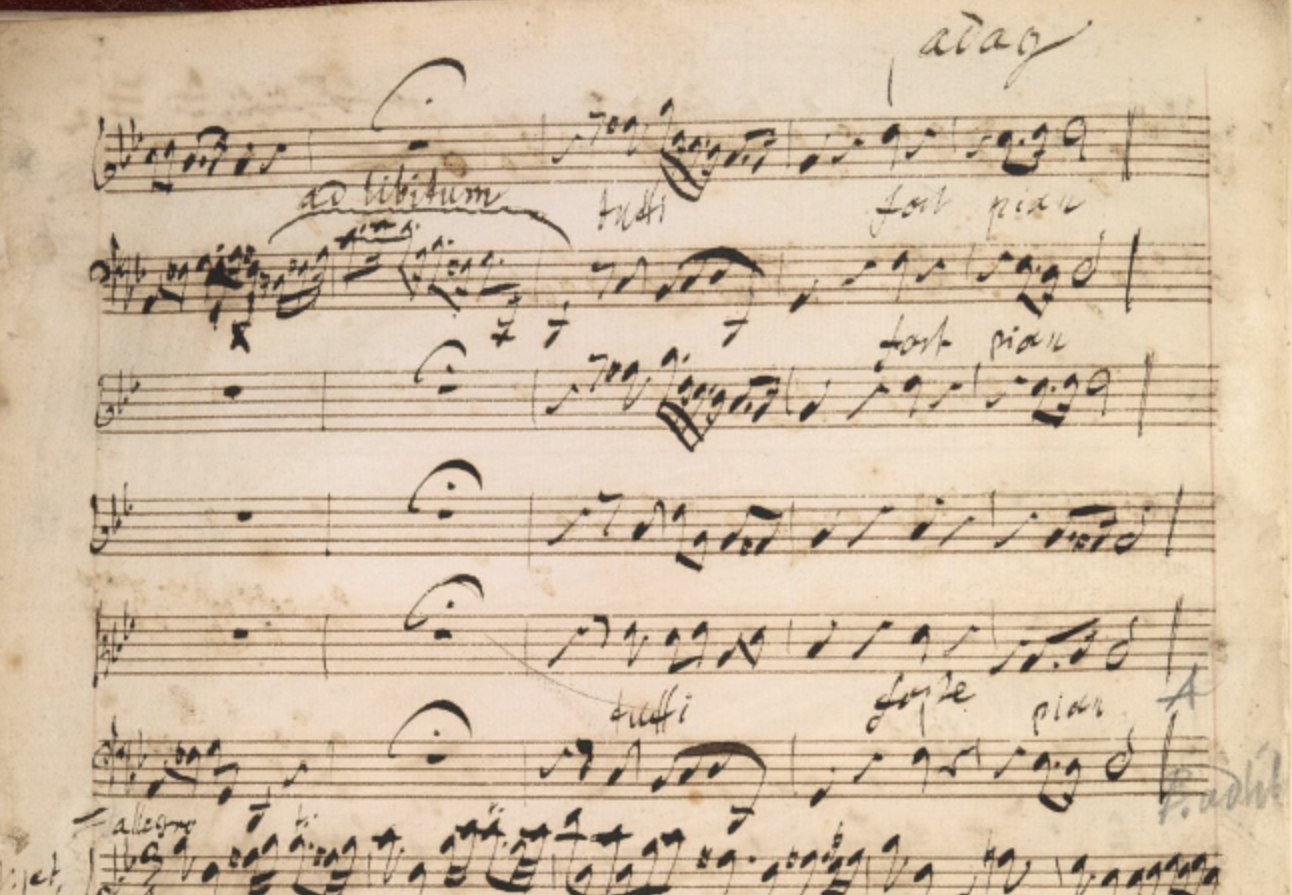
There are transitional Phrygian cadences in Handel that lack a new tempo designation, but I've never seen him use any designation for such a transition other than Adagio.  And thus, on occasion, one finds him appending this Adagio transitional gesture at the end of a movement that is already marked Adagio.  Here, for example, is the conclusion of the first movement of the concerto Op. 4 no. 3, HWV 291:

The significance of the image is the placement of the instruction "Adagio" above the final measures (in a movement already marked Adagio).
SOURCE:  cropped scan of Handel's autograph ms of HWV 291, now contained within BL Kings MS 317.  This detail is the top half of f. 12v, which gives bb. 26-30 of the first movement.
In case this is a little hard to read (and Handels writing often is), here is the same passage as it appears in the (revised) volume of the HHA:
This image shows precisely the same thing as the one above, but is easier to read because it is from an edition rather than a manuscript.
SOURCE:  cropped scan of Orgelkonzerte I, HHA Ser. IV vol. 2 (which superseded an insufficient 1955 volume of the same works); this detail is the bottom of p. 54, which shows bb. 26-30 of the first movement of HWV 291. 
Note the adagio instruction for the cadential transition in b. 30.  (Or is it really in b 29, as it seems to be in the autograph?)  But this movement is already marked Adagio from the start.  Significantly, Handel is not using the word to indicate a return to the tempo in b. 28 after the improvisatory cello passage.  There is no marking at all at b. 28 (i.e., a dog not barking in the nighttime); thus, he must have considered even an a tempo marking superfluous.  But the second adagio in b. 29/30 is a new instruction, not at all superfluous, nor (it would seem) merely redundant.  Handel moves from the Adagio mood of the movement to the Adagio gesture of the transition after the cadence.  (There is a similar situation in the first movement of Op. 7 no. 4 (HWV309), although in that case Handel was reusing a slightly longer movement, truncating it and adding the half cadence and the seemingly redundant Adagio instruction at that time.)

The editors of the HHA volume, Terence Best and William D. Gudger, evidently thought that the second adagio seemed out of place; their solution was the editorial footnote = più adagioalthough, as in Riedels interpretation of the Mahler Pausen this instruction is an interpretive prescription which seems to be speculative at best.  More Adagio?  Says who?  Granted, my reading is also speculative; but Id argue that 1) a blogpost is a fitter venue for speculation than a critical edition, and 2) mine is not an ad hoc solution to a unique textual problem, but seems more consistent with Handels usage generally.  (Does Handel ever use the instruction più adagio?  I wonder.  I dont know nearly enough Handel to pronounce on that, but something about it doesnt sound quite right.)

If Lawson and Stowell are onto something with their linguistic metaphor for musical instructions of the past, Id argue that there is no shortcutno Google translatefor our attempts to understand it and acquire any measure of fluency.  The past is gone, and we have no real way of immersing ourselves in it.  We are not the original listeners; indeed, we are not an intended audience at all.  We are eavesdroppers on a sometimes static-filled line in a game of textual telephone; to some extent, like the participants in that game, our interactions with the musical texts can affect their transmission to those who come after.  (In this blog Ive regularly returned to the problems editorial misreadings have caused by narrowing the interpretive possibilities.)  Returning to the earliest sources does not guarantee that we actually know what were reading, still less how.

If a blogpost is a proper venue for textual speculation, it may not be the best venue for pleas for humility, but that is how I will conclude.  The more we approach these texts with an awareness of the chasm between the lost musical experience and the accessible musical text as notated (or recorded)and with a willingness for the notations to mean something other than our common assumption of it, the better our chances (it seems to me) to approaching anything meaningful.   Otherwise, we are merely recreating the music in our own image, just as some may do with the Constitution of the United States... or with whatever you care to name, up to and including God Almighty.


15 December 2021

49. The sound of (editorial) silence

There is a temptation for an editor to select a variant reading that alters the sound of a work enough to be audible to musically-sensitive listeners.  (It provides for a certain frissonTheyre playing my edition!)  Some years ago I discussed Thurston Dart’s edition of the “Brandenburg” Concertos as an extreme case of in-your-face textual difference.  This is an temptation I had to learn to resist when editingbeing different for the sake of being different.

I stumbled across an example the other day.  I had been reading Christoph Wolffs new book, Bach’s Musical Universe.  I was struck by this passage, which concerns a group of chorales associated with the lost St. Mark Passion:

Moreover, their manner of four-part chorale harmonization shows a consistently greater degree of contrapuntal intricacy and rhythmic animation than Bach had typically brought to bear in the past, particularly in the inner voicesa trend that would continue in the Christmas Oratorio. [p. 226]

It never occurred to me that Bachs harmonizations improved as he aged.  Yet it brought to mind an e-mail exchange I had with a music theorist friend about a year ago about particular favorite Bach chorale harmonizations.  I had said then that my favoriteif I had to name onewould be the closing chorale of the first part of the Christmas Oratorio, a setting of Vom Himmel hoch da komm ich her.   That setting punctuates each phrase of the melody with a fanfare of trumpets and drumswhich I once liked very much, but which now I regard as an intrusion on the real stuff, the harmonization.  (In any case, the fanfares are striking, as they seem at odds with the text:  essentially Make for yourself a clean, soft bed in my heart, O sweet little Jesus, so that I never forget you.  (As a further aside, my guess is that it was this thirteenth strophe of Martin Luthers hymn which somehow gave rise to the false idea that Luther had authored Away in a Manger.  He didnt, but the sentiment is there.)  Some conductorsTon Koopman on the video linked above, and John Eliot Gardiner are examplesdownplay the trumpets and drums, as if not to wake the baby.  But I think Philip Pickett is right to have them thunder away:  the effect is not of a newborn but rather the King of Heaven beating on the door of my heart.)

I love this harmonization, particularly the last two phrases.  Spurred by Wolffs commentary, I pulled it out again and played it on the piano a few times.  The next day it was on my mind as I walked to my office, so when I got there I pulled the Dover reprint of the BG edition of the shelf and played it anew.  And right at the endIs this a misprint?  What is that D doing there?

SOURCE: BWV 248/ix, bb. 10–15; cropped scan of BG bd. 5 (ed. W. Rust, 1856), p. 48; from ISMLP #02418.

The D may at first appear odd harmonically:  the tenor crosses below the bass to produce a second-inversion subdominant chord.  But assuming that the continuo bass line has some instruments sounding an octave lower (double bass, organ?), then the true bass line is still below the tenor; thus no such solecism has occurred.  The voicing is unusual, but the harmony at this cadence offers no surprises.

SOURCE:  cropped scan of NBA II/6, p. 54
(ed. W. Blankenberg and A. Dürr, 1960) 

I wasnt expecting the D because it is not what I grew up hearing.  (The D is on the Koopman video above, though.)  What I heard for years is the reading in the NBA, where the tenor steps down to a wonderfully dissonant E.  I love that chord.  Now instead of IV we have ii, and my argument about the second-inversion is undone.  If we disregard the 16-foot doubling in the continuo line, the tenor becomes the bass of a (very proper) root position chord; but if we account for the octave doubling, we have an unexplained second-inversion chord.  That notwithstanding, I think it is a gorgeous effect.  And so I found myself wondering how it came to be, given that it was not in the old edition.  What was the story?


I turned next to the NBA critical report, which states that the autograph manuscript shows a correction from the D to the E, although the manuscript parts (tenor and viola) transmit the D.  Hmmmmm..Let's take a look at that autograph....

SOURCE: enlarged details from D-B-Mus.ms Bach P 32, Bl. 12v (from Bach Digital).  The detail on the left shows alto, tenor, bass, and continuo staves for bb. 11–13 of no. 9; on the right the fourth tenor note of b. 12 is further enlarged.

So... is that a correction?  To my eye the D [we are in tenor clef] remains much clearer than the smudge that is alleged to be an E.  I will admit that the smudge is rounded like a note-head, though it appears a different color and much lighter, and would have to have been made at a different time, maybe unintentionally.  When Bach isnt able to make a correction appear unambiguous (as, for example, the B which replaces an A as the very first choral bass note in the example above), he does something to clarify itas he does elsewhere on this same page.  In this instance, Bachs second thought was to let the third trumpet leap up rather than to repeat the same descending figure, but as the ink was smudged in the process, he clarified by indicated that the intended note was C.  (The lower C was sufficiently obliterated.)  
SOURCE:  same page as above; this detail is bb. 24 of the trumpet and drum staves. 

So why, then, did he not write the letter E in bar 12 to clarify the tenor correction?  

Because it wasnt one.  Sometimes a smudge is just a smudge.  Indeed, for a blissful moment I thought it might just be ink bleeding through the paper.  Here is a side-by-side comparison of the same detail of the Bach with a mirrored image of the other side of the pagemirrored, that is, to facilitate comparison of markings which are bleeding through:

SOURCE: marked, cropped scans from P32.  Left is the same image as above; right is the corresponding portion of the other side of the page (f. 12r).

You can see the shadows of a lot of the markings bleeding through, the clearest of which I have marked with red arrows.  Conspicuously absent, though, is any mark to bleed through to create the E smudge:  I have circled that spot in blue.  But keep fol. 12v (with the chorale) was the last page of a fascicle, and it shows signs of other ink transfer (marked in yellow)having been put down on top of something else. My guessand it can only be a guessis that the E smudge (which is very close to the area marked in yellow) is a similar offset transfer.  In any case, it's not an E.

If that smudge were an E, Bachs figured bass should reflect it.  The figures transmitted in the continuo part (not in the score) show know signs of alteration.  (Those figures appear in both the BG and the NBA examples above.)  Nothing accounts for the E in the harmony; and in no other source is an E transmitted.  If this was indeed a second thought, Bach apparently didn't think it was important to have anyone actually perform it.  But I would argue instead that this reading is the wishful invention of Walter Blankenburg and Alfred Dürr, editors of that volume of the NBA.  Id hate to see it go; I think it sounds fantastic.  But it has no textual authority, and is thus usurping the rightful place of the authoritative D.

All of this is a lot of words spent on a single quarter note; but it is an example, I think, of an editor opting for an audible difference even without the evidence to support it.  For a considerably more egregious example, get a load of this:

SOURCE:  cropped scan (p. 61) of BA 10303-01, C. Saint-Saëns, 3e Symphonie en ut mineur, op. 78, vol. 3 (ed. Michael Stegemann) of Camille Saint-Saëns:  œuvres instumentales complètes (Bärenreiter, 2016).

This new critical edition of Saint-SaënsOrgan” Symphony is marred by an astonishing number of typographical errors; it really merits a post of its own just for that reason, and maybe I will get around to that someday.  But what appears above is not an error.  It is what the editor (Michael Stegemann) meant.  In case there is any doubt of that, here is the remark in the critical commentary, together with my scrawled commentary in the margin.  Pardon my French.

SOURCE:  cropped scan (p. 206) of BA 10303-01 plus pencil annotations

On no authority whatsoever, Stegemann interrupted the composers very carefully contrived legato arpeggio, inserting a break right before the downbeat of b. 365.  (Say what you like about it, it is an audible change.) Other than the dotted-slur in the cello, there is no indication on the page that a change has been made, and users who do not consult the notesor who do not already know the piece very wellwill be none the wiser.  This edition has been issued as a much less expensive offprint, and Bärenreiter reports to me that typos (all of them?) have been corrected, but that edition appears without any of the critical commentary.  Users who trust the Bärenreiter Urtext marketing (the last word in authentic text) may well assume this represents responsible editing.  Caveat emptor.

If Stegemann had left this text as he had found itif, that is, it appeared as in all other sources (including the first (1886) and second (1907) editions, issued by Durand)he would not be neglecting his editorial duties.  An editor is still doing the job even when the decision is made to let any given reading stand without alteration.  But maybe an editor only feels like an editor in the act of emending something.  What is the sound of an editor not changing the text?

A few weeks ago I was amused to see someone in a Facebook group posting their various complaints about eccentric readings in the Bärenreiter edition of Handel's Messiah.  (What the post referenced is the vocal score published by Bärenreiter, which is a reduction of the text of the Hallische Händel-Ausgabe (the HHA), but the textual decisions are not Bärenreiters editorial responsibility.)  The person was essentially complaining that this is not the textus receptus, and that Bärenreiter should just get in line.  I suppose the Novello edition is the closest thing to a standard edition now, having (in this country) replaced the old Schirmer edition.  But people use all sorts of editions all at once, and a few years ago in this blog I was grumbling about orchestral players bringing their own partbooks from different setsleading to a chaos of conflation in performance.

A particular example the writer cited was from the climax of the Hallelujah chorus.  Here is the reading of Bärenreiter vocal score:

SOURCE:  cropped scans of pp. 247 and 248 of the HHA vocal score of Messiah, ed. John Tobin (Bärenreiter, 1965).

The textual surprise here:  the words sung in bb. 76-77.  We expect and Lord of Lords, yet we get and He shall reign.  But the HHA is a scholarly edition... or rather it became a scholarly edition after a rocky start and a number of superseded volumes.  The editor of Messiah, John Tobin, thus had no interest in what people have come to accept as Messiah.  He was interested only in what the authoritative texts convey.  My advice:  If the user doesnt want to put up with a scholarly edition, then buy something else instead.  There are plenty of alternatives.

Perhaps and He shall reign is not what Handel intended here, but Tobin did not make the choice capriciously.  Here is this passage as it appears in Handel's composing score:

SOURCE:  scan of British Library RM 20.f.2, p. 205 (scanned from Bärenreiter facsimile edition).

Observe that both texts appear:  and He shall reign below the altos, and Lord of Lords below the tenors, and and He below the basses.  This bass and He is the only one in Handels hand.  The alto and tenor words have been inserted by his assistant, John Christopher Smithand the smudge indicates some degree of uncertainty.

Smith was the copyist of the conducting score, a fair copy with some autograph insertions of new and revised movements, and a host of other markings in the composer's hand.  Here is the relevant page:

SOURCE:  scan of GB-Ob MS Tenbury 347 f. 96v, from the Scolar Press facsimile (1974).

Here there is no ambiguity.  Maybe Smith got it wrong, but there is no sign of correction here.  Tobin thus felt justifiably obligated to print and He shall reign (as did some of the earliest editions) because that is what the most authoritative sources transmit most consistently.  If you dont like it, tough.  You dont have to sing it that way; alter as you see fit, but dont complain about a scholarly edition being scholarly.  

This issue of sticking with the authoritative textcome what mayhas now hit home for me in a new way.  In the last year, I have been asked to assist with the completion of an edition that is already 75% done.  It is a critical edition of Princess Ida, a Gilbert & Sullivan opera that premiered in 1884, the immediate predecessor to The Mikado.  It is a scholarly edition, although with vocal score and orchestral parts prepared to facilitate its use in performance.  I have a student assistant; her first task has been just proofreading the text of the full score as it has been set against Sullivan's autograph.  She has done great work with this, and it is so good to have another pair of eyes on this sort of project.

A few weeks ago I got a text from her:  I had a question about the lyrics, but we can discuss it another time if you're too busy.  I was intrigued, mainly because the lyrics are not our task at the moment.  This edition has a policy of divided authority:  the autograph full score is the principal authority for the orchestral parts; the second state of the first edition of the vocal score is the principal authority for the vocal parts, the lyrics, and the text underlay; and a certain edition of the libretto is the principal authority for the dialogue.  So we weren't concerned about the lyrics as such at the moment.  What would her question be?

Actually, I should have foreseen it.  This was the page of proofs that prompted it, although it appears here as I think it should in print--with the offensive n-word redacted:
SOURCE:  cropped scan of proof of p. 197 of new critical edition of Princess Ida (forthcoming), no. 12, b. 109–112; I have redacted the text.

Of course she asked Why is this word there?  At the very least, why is it not relegated to the footnote, with the substitute text in the score proper?  As this edition seeks to establish the text as it was settled in the first run, the line quoted in the footnote is extraneous, and certainly doesnt belong in the main text of the score.  But I feel strongly that we can't print what Gilbert wrote.  All the same, we cant hide what Gilbert wrotewe need to leave the ugliness on display, or else we let Gilbert off the hook.  Princess Ida is a troubling piece in many ways, particularly as the focus of Act II is lampooning women's education generally.  (The joke, as it happens, is on Gilbertor at least on his chauvinist characters.  They rattle off a list of impossible things that these girl [sic] graduates hope to accomplish; but several of the items on that list have actually come to pass since 1884.)  But ugly and troubling texts still need to be presented, and in ways that don't simply bypass the problems.  

Several years ago, at my previous institution, one of my responsibilities was directing the chamber orchestra.  I had great fun with it, particularly as the instrumentation changed substantially each year as students graduated and matriculated.  There were always new challenges and new opportunities.  One year I had such an idiosyncratic ensemble that I rashly decided to compose/compile/arrange a score to accompany a silent film.  If I had realized what I was getting into, I would never have done itbut it proved to be great fun despite the labor that it entailed.  I settled on a Buster Keaton film that I felt sure would appeal to my undergraduate audience:  College (1927). 

But there is a short scene right in the middle of the film where Keaton is in blackface.

SOURCE: cropped screenshot at 29:14 from the full film, available on youtube.

I considered skipping this scene in performance; I briefly considered not even scoring this film at all.  My solution, ultimately, was to show the film, but for the orchestra to remain tacet throughout the four or five minutes of the blackface scene.  We thus could present Keatons film intact, butby remaining silentpointedly not endorse it.  Or at least that was what I was hoping we could do.  We could remind the audience that in the midst of the brilliance and finesse, there is an ugly and indelible stain that is more than just an artifact of its time.

So too in this edition of Princess Ida, I want the ugly stain to be clear, even if I dont feel we can actually print the n-word.  The opera dates from 1884, but the edition is a product of the early twenty-first century; our edition inevitably will reflect our historical moment, too.  At the moment, the black-box redaction (in the style of released government documents) seems the best way to do be faithful both to Gilberts text and our present interaction with it.  The page is visibly scarred, but the content of the text is still clear.  And anyone who wants to see what Gilbert wrote can easily consult a multitude of other sources.

To do otherwise in such a casethat is, to print the text as it stands, to remain silent as an editoris simply not an option.  The editorial silence would be deafening.


01 November 2018

37. Corroborative detail

I will begin with what was intended to be a digression, but has ended up taking over the post:

There is a charming detail of orchestration in the trio Three Little Maids from School in (Gilbert &) Sullivans The Mikado (1885).  Just as Yum-Yum, Pitti-Sing, and Peep-Bo are finishing up the refrain, they pause:
Three little maids who, all unwary,
Come from a ladies seminary,
Freed from its genius tutelary

And in that moment, with the whole orchestra falling silent, a bassoon bubbles into life.


That bassoon idea was an afterthought.  A glance at the composers manuscript shows not just a blank bar at this point, but that originally he had notated a rest (in ink).  The bassoon effect has been pencilled-in later:
SOURCE:  cropped scan of the 1968 facsimile of the autograph score of The Mikado, p. 143 (bb. 4046a)
And there does not seem to be any document to establish with certainty when it was added.  By the 1880s, Sullivans practice was to sketch the musical numbers (and here is such a sketch for Three Little Maids), and then transfer the vocal lines onto the pages of what would later become the full scoreruling in the bars as necessary, but writing in only enough to give a copyist a means of preparing a sort of rudimentary vocal score for rehearsal.  The numbers would not be done in the order of the show:  the choruses and ensembles generally came first, with the solos later.  Only after the whole of the opera was framed would Sullivan turn to the orchestration, filling in the blank staves.  When the full score of a number was complete, the orchestral parts could be prepared and the keyboard reduction for the published vocal score finalized.

Mike Leighs 1999 film Topsy-Turvy, which dramatizes the months preceding The Mikados premiere, missed the chance to realize this moment.  Although there is a scene in which Sullivan has an exchange with the bassoonist, we do not see him have a flash of inspiration in the pit, handing down last-minute instructions to gurgle away.  Fun as that might have been, it is probably just as well that no such scene occurs, as we do not know that this episode occurred in the rehearsals for the first production.  Then again, the bubbling bassoon figure is played in performance in the movie, when by rights it should not have been.  It does not appear in vocal scores until the twentieth century; but admittedly, Sullivan took nowhere near as much care with the published scores as Gilbert did with the published libretti.  The absence of the bassoon whinny in the vocal scores (and the distinct piano-only score, which derives from the vocal score) is not strong evidence of anything beyondas we know alreadythat it was not originally there.

Is it even the composers amendment at all?  I believe it is.  That the idea was an inspiration in the pitas characterized aboveis suggested by the notation in the manuscript:  the contour of the figure is there, but it is unclear what the pitches should be and one would certainly not guess from this scribble that the first note is d'.  This emendation his was not notated here for the eyes of a copyist; it appears to me to be nothing more than a hastily-added aide-mémoire to the composer of this addition.  Indeed, the strongest bits of evidence that this pencilled addition is indeed by the composer are 1) it is in the autograph, which in performances would have almost immediately been supplanted by a copyists conducting score of some sort; and 2) the bassoon is so imprecisely notated.  I would expect anyone else making such an interpolation to make it as neat as possible.  (In any case, the bassoon part needs the actual pitches much more than the full score does.)

For this to be Sullivan's own interpolation would require an occasion when the composer and his autograph score (not a company copy) were both together back in the pit to conduct a rehearsal, since this change could not realistically have been added during a performance.  As Sullivan generally did not often conduct after the opening night of an initial production, the possibilities for such an occasion after March 1885 are slim indeed.  He did, however, conduct the opening night of a revival at the Savoy Theatre on 6 November 1895, and he may well have rehearsed the company before that performance.  (Not having his diaries at handalthough they are extantI cannot answer that question definitively at the moment.)

Two tidbits suggest that this 1895 production (rather than the original) was the occasion for the change.  One is the account of Thomas Dunhill, in his Sullivan’s Comic Operas:  A Critical Appreciation (1928):
[C]ould anything show more witchery than the use of the silent bar, just before the end of two of the verses?  Was Sullivan afraid that it could never be silent enough when, on the occasion of rehearsing one of the revivals, he broke this silence by pencilling a little curling phrase into the bassoon players part?  This stroke is amongst the most delicious of after-thoughts, but it is not in the original score.  One would gladly hear the passage both ways, on different occasions.  [pp. 131f.] 
The second tidbit is that the 1893 full score of The Mikado published by Bosworth (a German firm  heavily backed by Sullivan) has the original gran pausa here:  the autograph seems to have been the source for the Bosworth edition, so if the amendment had been made by 1893, the lithographist preparing the new edition apparently didnt take it seriously:
SOURCE:  cropped page-scan of Kalmus reprint of Bosworth full score, p. 139, from IMSLP #30034 (bb. 4043)
(I was a little surprised to find the bubbling bassoon absent from the 1907 recording as well, but in that instance the music had been heavily rescored to be audible with pre-electric technology, and I wouldnt be surprised if the orchestration was done from the published vocal score, if not the Bosworth scoreboth of which lacked the figure in question.)

I have no doubt thatas Dunhill assertsthe idea is Sullivans own, but the case is not airtight.

As I say, all of this was supposed to have been a tangential point; I was going to introduce it because it seemed like an example of an musical detail conceived later than the rest of its context, perhaps suggesting itself to the composer because of the different activityconducting a rehearsal with orchestra rather than composing in silence at his desk.  There are many examples one might use to illustrate such second thoughts, but I had thought this would be a fun one because some years ago I noticed that on 12 March 1885,  two nights before conducting the premiere of The Mikado, Sullivan had conducted Beethoven's Symphony no. 4 at the Philharmonic Concerts.  What if (I had thought) the giggling bassoon line was suggested to him by a celebrated bassoon solo in Beethovens finale?  (Granted, Sullivan's line resembles better the figures in the finale of Mozarts Symphony no. 39, but never mind.)  Wouldnt that be loverly?  Only as I came to look at it more closely did I see that there was not enough evidence to connect it to the Beethoven, so then I might as well use any example I liked.  I just got stuck on this one.

Having let the tail wag the dog for so many paragraphs, I will let the dog bark briefly here.  A few evenings ago I played the first movement of Alexandre Guilmants first organ sonata in a recital of Scary Organ Music.  It is a piece I first came to know as his Premiére Symphonie pour Orgue et Orchestre, op. 42 (1879)hearing it (as mentioned in a previous post) in a splendid recording conducted by Yan Pascal Tortelier; only later did I learn that the work started as a work for organ alone, the Premiére Sonate pour Orgue, also Op. 42 (1874).  The piece works so well for organ and orchestra together that it is hard to fathom that it was not originally conceived that way.

Below is a stemma of sources for these two versions that I have been reviewing in recent months.  The shaded boxes are sources I have not examined; the red text/lines trace the transmission of the orchestral version, while the black follows the organ solo version.  It will be seen that there is a complex interrelationship between the two versions, as ideas that crept into the orchestration gradually make their way into the text of the solo versiona few in the second edition, a few more in the third.   (Double lines indicate reprints of the same text.)

By far the bulk of these changes are rhythmic articulations where the original (in so far as I can determine it) had only sustained chords.  Thus, at the conclusion of the first movement (here copied from the 1876 Schirmer edition, but the Bärenreiter critical commentary testifies to the same reading in the autograph), Guilmant wrote:
SOURCE:  cropped screenshot of Schirmer edition (IMSLP #290298), p. 13, showing I/353359.
In the second edition this passage already has some substantial changes (marked in red below).
SOURCE:  cropped scan of Leupold reprint of 2nd edition, p. 45, showing I/353359 (my hightlights added)
All of these, in fact, have their origins in the orchestration, the chords at bb. 355–56 rearticulated with an antiphonal effect between organ and orchestra, and the brass introducing the new figure at the final cadence (with consequently shorter note-values for those penultimate chords):
SOURCE:  cropped screen-shot from the first edition full score (IMSLP #245332), p. 43, showing I/354359.
Rather than belaboring this point (as I had originally intended to), I will confine myself to one additional examplea change which does not make it into the sonata until the 1898 third edition, although clearly comes from the 1878 orchestration.  Here is the opening of the first movement as in the Schirmer edition (and the reading is identical (save for French-language registration markings) in the second edition):
SOURCE:  cropped screenshot of Schirmer edition (IMSLP #290298), p. 1, showing I/13.
Now here is the opening of the first movement as in the third edition:
SOURCE:  cropped scan of Leupold reprint of 3rd edition, p. 1, showing I/12.
(And don't get me started about all those slurs.)  Again, the dramatic rhythmic punctuationwhich he has very cleverly accomplished by the engaging of a manual coupler to a chord already being sustainedhas its origins in the orchestration:
SOURCE:  cropped screen-shot from the first edition full score (IMSLP #245332), p. 1, showing I/12.
Clearly Guilmant liked the effects he had devised for the Symphonie, and he found ways of folding them into the Sonate.  This evokes The Mikadonot just the added bassoon in Three Little Maids, but also one of Gilberts lines of dialogue.   In Act II Pooh-Bah justifies his graphic embellishments to Ko-kos (entirely fabricated) account of executing the emperor's son thus:
Merely corroborative detail, intended to give artistic verisimilitude to an otherwise bald and unconvincing narrative.
(Actually, this takes us back even to Topsy-Turvy.  If the film missed the opportunity of highlighting a textual change of the score, it does in fact depict Gilbert making a textual change to the libretto during a rehearsal, adding the word otherwise to this line.  I am not aware of any evidence to support that, but it is a nice moment.)

If we take Pooh-Bahcorroborative detail to be ameliorations made after the fact to an original that was already sufficient in itself, then these details manifest that sort of corroboration.  Neither Three Little Maids or Guilmants organ sonata is bald and unconvincing in its original version, but I think the addition of a little corroborative detail paid off in both cases.